
 |
| Emptiness - in my soul |
Surely other people cry and make the pouty face when they see a pale, yellow yolk puttering in the pan.
My husband has been consoling me with promises of our very own chickens when we move. That helps a little.
There is some sunshine after all. It's finally spring and eggs are in season!
My “egg dealer” – we’ll call her mama pollo (heh heh) -- is back in business now that “the girls” (as she affectionately calls them) are laying more regularly. So mama pollo is a friend of mine that raises her own chickens outside of the city in a suburban neighborhood. She wanted eggs from chickens that were treated well, ate well and had good living conditions; one way to ensure that, was to do it herself. I love it.
Meet Belina – chilling on the back deck ...
 |
| Photo by T. Allen |
The key to pastured chickens is that the hens have a covered place to roost and rest; fresh air, can primp and preen; and can freely forage for bugs and greens (their natural diet). Eating bugs makes them happy. And happy, healthy chickens lay delicious, healthy eggs.
Check out the yolk from a happy chicken compared to a yolk from a chicken in a conventional get up.
 |
| Yolk from happy chicken |
 |
| Yolk from chicken in conventional outfit - "the basic grocery store egg" |
By “conventional” I mean: either factory farmed in warehouse barns (photo below) or crammed into small wire cages (called batteries) with other chickens and no room to hardly move; they are given a feed that consists of mostly genetically modified (GMO) corn (because it’s cheap) and possibly antibiotics, as they are often sickly under these conditions (geez, who wouldn’t be). There is far more that can be said about how chickens are being factory farmed these days, but essentially, they are used soley as egg-making machines, have awful living conditions, are stressed, cranky, pissed at their neighbors and fighting all the time; less healthy, not eating their natural diet or able to roam freely as their ancestors before them once did. This set up allows manufacturers to produce higher volumes of eggs which can in turn be sold to us at a lower cost, ~$2/dozen.
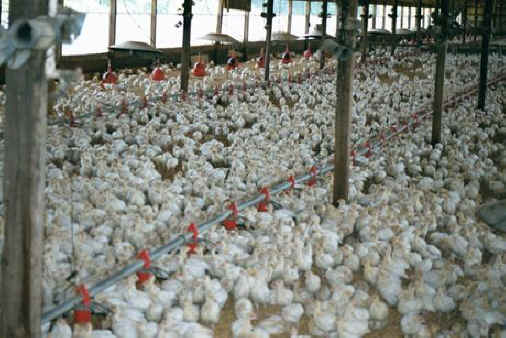 |
| Factory Farmed Chickens / "High Density Floor Confinement" (Photo via) |
Knowing this, purchasing quality eggs is one area on my grocery list that I just won't skimp on.
And oh baby... it’s SO worth it! Eggs from pastured chickens have a deeper and sweeter taste. The yolks are golden in color and plump and proud in stature.
Want more reasons to go out of your way for pastured eggs?
Pastured eggs are nutritionally superior:
Want more reasons to go out of your way for pastured eggs?
Pastured eggs are nutritionally superior:
· Up to 10x more omega-3s (roles in brain/nervous system health, joint health, vision health, immune support, anti-inflammatory, etc)
· 3x more vitamin E (anti-oxidant functions, immune building, cancer preventative, preventative against CVD, anti-inflammatory, etc.)
· 7x more beta carotene (vision health, immune function, gene expression, growth & development, etc.)
· 5x more vitamin D (immune function, nervous system, bone health, gene expression, etc.)
· No added hormones, antibiotics or other drugs (the way it should be)
· Less cholesterol and saturated fat (still worried about fat and cholesterol content of eggs? Check out the: Let's Talk Fat post)
· Rich in conjugated linoleic acid, CLA (more on CLA in a later post; you're gonna want to know about this “good fat” known for being a potent defense against cancer and more --- stay tuned!)
OPTION #1
If you know someone who raises their own chickens in a healthy environment as mentioned above, you are golden. And be kind to your local mama pollo. Expect to pay $3-$5 per dozen. Or if you are super lucky, you might have a generous neighbor who just keeps you in supply with their extras.
OPTION #2
If you have a local farmer’s market, get there early and purchase from a local farmer that adheres to the organic pastured standards (just ask). And of course, be kind to your local farmer as well! Expect to pay $4-$6 per dozen.
OPTION #3
Purchase eggs from your local natural foods market. Read the label as best as you can looking for: organic and pastured. Expect to pay $3-$4 per dozen.
Organic on the label means: ~80% of their feed is from non-GMO and there are no animal by-products in the feed; they have access to the outdoors year round and are allowed 2 sq ft of floor space.
Pastured on the label means: chickens are typically in a moveable enclosure where there is access to fresh growing vegetation.
But let's be clear: there are numerous words on egg cartons these days (free range, cage free, day range, free roaming, roaming free, etc). For example: "free range" on the label doesn't necessarily mean or guarantee anything... it's loosely regulated, further making understanding egg labeling torturous and confusing --- which is why options 1 and 2 are preferred. Rodale has a nice article on new labeling laws that may come into play making this easier on the consumer.
Here's a fantastic link that can help you find a CSA or farm in your area:
http://www.localharvest.org/
Does all this make your head spin? Yes, mine too. Let's move on to the eating part.
The egg is gloriously versatile and is used in baking, meringues, Italian desserts, eggnog, cocktails, stirfries; it can be scrambled, cooked over easy, poached, fried, hard boiled; you can make omelets, quiches, soufflés, frittatas, you name it! It's a chef's delight, for sure.
One simple breakfast favorite in our house is an egg over easy/medium served over a bed of quinoa. ...Along with some fresh ground kelp and a generous handful of cilantro (yes, we sort of like cilantro!).
 |
| Pastured egg over easy over bed of quinoa with side of fruit |
But another favorite is making a frittata, which can easily make a delicious, high protein, veggie-filled meal for breakfast, lunch or dinner. Below is a recipe for a Savory Vegetable and Caramelized Onion Frittata.
So.... what is your favorite egg dish?
And tell me I am not the only one who dreams of living in the country again ... a big yard complete with a designated chicken playground and all the fresh pastured eggs I can imagine...?
 |
| Savory Vegetable and Caramelized Onion Frittata |
And tell me I am not the only one who dreams of living in the country again ... a big yard complete with a designated chicken playground and all the fresh pastured eggs I can imagine...?
Savory Vegetable & Caramelized Onion Frittata
________________________________________________________________________
Frittatas are such a wonderful way to kickstart your day by serving up a flavorful dish, high in protein and packed with a bounty of beautiful vegetables. For a balanced meal, partner this fabulous frittata with a side of whole grain toast and fresh, in season fruit topped with a dollop of cultured whole milk yogurt. Feel free to change up the spices and the vegetables to suit your fancy – it’s hard to go wrong!
________________________________________________________________________
Preparation time: 30 minutes
Makes 2-4 servings (6 slices)
2 teaspoons butter, divided
½ yellow onion, sliced into half moons
4 shitake mushrooms, thinly sliced
¼ red bell pepper, julienned
2 cloves of garlic, roughly chopped
2 leaves of kale, coarsely chopped
6 eggs
3 tablespoons whole milk
¼ teaspoon sea salt
¼ teaspoon ground white pepper
1 teaspoon ground coriander
3 tablespoons coarse grated carrot
2 tablespoons fresh chopped parsley, plus more to garnish
1/3 cup grated mild cheddar cheese
Set oven to broil.
Heat a medium-size stainless steel pan over medium heat. Add 1 teaspoon of butter. Add the onions and cook for about 15 minutes until they are almost caramelized. Add the mushrooms and bell pepper. Sauté together for 3-4 more minutes. Add the garlic and kale and cook for another minute or so until kale turns bright green and begins to wilt. remove from heat and set mixture aside.
Whisk eggs and milk together in a medium size bowl. Mix in the salt, pepper and coriander. Over medium-high heat, re-heat the same pan that was used to cook the vegetables and coat evenly (especially around the sides) with the remaining teaspoon of butter. Add the egg mixture and cook about 75% of the way without stirring; there will still be uncooked yolk on the top. Add the cooked vegetables and then top with the carrot, chopped parsley and cheese.
Place the skillet in the oven to broil for about 3-4 minutes, until the cheese is a little golden and bubbly. Keep an eye on it so it doesn’t burn Remove from the oven, slice into 6 pieces and serve garnished with a little extra parsley.
Copyright 2010, S. Nester, Original recipe


