Showing posts with label spring. Show all posts

Saturday, June 4, 2011

Wildly Wonderful: Nettle Tea

Stinging Nettle, surrounded by 
Horsetail (photo via)
It's quite amazing to be able to walk outside your door and harvest food from a garden you planted and helped nurture to life, but it's a whole new level of amazing to walk in the woods and harvest food that grows in the wild.  It’s both mystical and most splendid.  I pause for a moment and close my eyes to wonder about those who have harvested here even hundreds of years before me.  There is history here and these plants know it. 

There is an even specialer (that's right) energetic quality about harvesting plants like this.  They are resilient; they thrive on their own and they fiercely endure the elements and the attempts of predators; they grow in harmony with the seasons.  These survivors have a naturally potent life force and are without question, nutritionally superior.

The Stinging Nettle, Urtica dioica, is armed with hairy-looking prickles that carry formic acid, oxalic acid and histamine, to name a few.  This is a built-in chemical defense mechanism that causes a bit of burning if stung.  Anyone who has harvested them knows this oh so well!


Dried nettle leaf
When I harvest, I go armed with my garden gloves, grocery bags and scissors.  I always assess the area and make sure I am harvesting sustainably, that I am not taking more than I need and so that it looks as if I was never there.  Be sure to only harvest plants you can identify and only healthy, vibrant ones. 

I am so captivated by seeing my food grow in the wild.  It’s worthy of taking a moment to extend my gratitude.  People do this in many ways.  Some take a moment of silence before they harvest and simply whisper, “thank you.”  A former teacher of mine said she liked to sing to the plants while she harvested.  Lord knows if I did that, they would likely uproot themselves and run or bend over and cry.  No one has really ever heard me sing (not seriously at least) and for good reason.  I like having friends.  All that to say, do what you think would honor the plant the most.  I like to give thanks for its beauty, its nourishment, its strength and its life force.  I take a moment to see it.  I smile. 

Maybe years ago I would have thought this was crazy business, but after tucking seeds in the ground with my bare hands and after watching those very seeds spring to life, there is clearly far more going on with the food I eat than I have given credit to before.  After picking fresh, wild flowers from a field or helping to butcher ducks at Quillisascut Farm, I have experienced a spectrum of life that has caused me to arrive at the conclusion that I should be both thankful and responsible for knowing where this food came from.  Too many people know what food looks like neatly packaged on the grocery store shelf, and too few know what their foods look like fully alive and thriving.  We should know.  Without which, we must be so disconnected to the very land beneath out feet.   

Gratitude is due.  This food sustains us and we must never forget that.

9 lbs of dried nettles at Herb Pharm's Farm - I'd say hugs are in order
Nettles is hands down, one of my favorite wild edibles.  They grow abundantly here in WA, so it wasn’t until about 2 years ago that I had the opportunity to fall so in love.  The sun surprised us and popped out one day a few weeks ago while at school so a couple of my classmates and I went foraging on our break.  It is preferable to use fresh nettles, but they also dry so nicely in a paper bag in the trunk of my car.  That’s the lazy way to dry your nettles, but it works, so I’m game.  The "appropriate" way to dry nettle leaves is to spread them out on drying racks indoors with circulating air.

The paper bag-trunk drying method
By consuming nettles, they offer their energetic quality of strength to our bodies that I mentioned earlier; also, nettles is:
  • a diuretic – in short, it moves stuff out, causing urination and cleansing of the kidneys, a fabulous detoxifier
  • anti-allergenic - it may be used for asthma and other allergic conditions
  • used in treating enlarged prostate
  • impressive with a nutrient profile rich in calcium, protein, iron, magnesium and potassium
  • highly beneficial (because of all the minerals) and often safe during the 2nd and 3rd trimesters of pregnancy and for nursing mothers, but of course, talk with your health care professional first
Here's what I'm talking about...we know how good kale and spinach is for us, right?  Although, they are all phytochemical-rich leafy greens, they pale in comparison to nettles.

Plant Nutrients
RDA
SPINACH
KALE
NETTLES
CALCIUM
800
102
206
2900
MAGNESIUM
300
96.8
37.4
860
IRON
18
2.96
1.8
41.8
POTASSIUM
1875-5225
518
244
1750
VITAMIN A (IU)
4,000IU
8,920IU
9,130IU
15,700IU
VITAMIN C
60
56
102
83
THIAMINE
1
0.116
0.11
0.54
RIBOFLAVIN
1.2
0.22
0.2
0.43
NIACIN
13
0.6
1.8
5.2
ZINC
15
0.618
0.78
4.7
MANGANESE
2.5-5.0
96.8
37.4
860
SODIUM
1100-3300
98
47
4.9
PROTEIN
3.60%
5%
10.20%
16.50%
*Numbers indicate milligrams per 100 grams, about 1 cup fresh or 3 1/2 ounces dried.
*Data based on USDA research “The Composition of Foods” in “Nutritional Herbology”

Here’s another reason why nettles ranks high on my list. It’s not only a tasty source of food and has fabulous medicinal properties, but its fibrous stems have been used for hundreds of years for making cords and nets.  This totally appeals to my pragmatic side.

Photo via
Ok, now for the delicious part.

With freshly harvested nettles, you can pretty much cook them in the same way you would use spinach in recipes. They are fantastic in soufflĂ©s, sautĂ©ed in pasta dishes, blanched and blended into smoothies as well as for pesto-making.  

When you harvest them fresh, you can either cook them up right away or let them dry (both of which will take the sting out). The dried leaves store best in an air tight jar in a cool, dark place.

For now, I wanted to post the most simple way to incorporate nettles into your home kitchen and medicine cabinet.  Since dried nettle leaf tends to be the most accessible to folks, let's make an infusion!  My husband (who was not exactly thrilled about the idea of drinking wild-foraged greens), loves nettles cold infusions sweetened with Florida crystals and iced up just like a good old southern iced tea.  My friend DeAnn loves to add fresh lemon juice to hers to make a Nettle Lemonade.  The recipe below is the bare bones and a canvas for you to sweeten, flavor and ice up how ever you desire. 

Have you tried nettles before, fresh or dried?  What's your favorite way to enjoy them? 

Nettles Cold Infusion
_____________________________________________________________________________________
 A powerhouse of medicinal and nutritional goodness, nettles are far superior to other leafy greens and are incredibly rich sources of protein, calcium and magnesium.  This simple cold infusion can be pepped up by adding a little peppermint tea, oat pods or your favorite citrus zest.  I find that using a French press is a convenient way to press out the nettles.
_____________________________________________________________________________________

Preparation time: 2 minutes, plus 6 hours hands-off infusion time
Yields: 1 liter

¾ - 1 cup dried nettle leaf
1 liter filtered, cold water


In a liter size glass jar or larger, combine nettles and water.  Stir, place a lid on it and let it rest on the counter for 6-8 hours.  Filter the nettle leaf out and compost.  You can sweeten to taste with honey, stevia, unrefined sugar or enjoy it by itself.


Copyright 2011, S. Nester, Original recipe

Friday, May 13, 2011

Strawberry Lavender Rhubarb Sauce – All Over My Body

Wait, I  mean, all over my ice cream.  It’s scary how much I like good food.  But doesn’t everybody mix those sorts of things up? 

My husband often picks on me for the odd things that make a home in my purse.  I get it.  There’s usually something herbal, something ginger, a water bottle, a long lost apple, more snacks and some lip gloss to name a few things.  To add to the mix this week, some beautiful stalks of pink rosey, in-season rhubarb.

Wallet. Check. 
Keys. Check.
Rhubarb. Check.
My naturopathic doctor ever so kindly hooked me up with some rhubarb from her garden today.  Freshly cut right out of the ground and into my purse it went as I headed home from my appointment.  I am obsessed with gifts from the garden, handfuls of raw food not neatly packaged; sweet smelling and still delightfully dirty from just being uprooted. 

I used to have a darling little garden plot at my work’s community garden and grew loads of basil and tomatoes.  On the way home from work in the summer, my passenger car seat would be filled with fresh picked basil and romas.  I grinned the whole way home. 

Rhubarb is quite mesmerizing.  When it boldly shoots out of the ground with its proud stalk and one awkward, elephant ear-like leaf, it's a proclamation that spring has arrived.  This firm, pale green, hearty stalk is usually blushing with a delicate pink or cherry red (depending on the variety); it shimmers beautifully in the sun with sort of an iridescent, angelic glow about it.   


Rhubarb has been used medicinally and in culinary concoctions for thousands of years, especially in Chinese medicine.  It's known for balancing digestion and for getting the bowels 'amoving; it's cooling and detoxifying to the liver.  Rhubarb is also rich in vitamin C and potassium.


It makes good sense that it arrives in the spring just in time to offer us a spring cleaning and vibrant transition out of the slump of the winter months. 


Also, rhubarb is most fascinating in that, it’s technically a vegetable --- from the buckwheat family.  I’m getting in vegetables by eating dessert?  SOLD.  It's tart and astringent which is why you often see it paired with something sweet like strawberries. 

I got excited thinking about the myriad of things one could create with rhubarb, but hey, why fix what ain't broke?  The lavender buds add a subtle flare but really this sauce is simple and honors the intrinsic deliciousness of the rhubarb and strawberries.


This simple and tasty recipe for Strawberry Lavender Rhubarb Sauce is below --- enjoy!

Is rhubarb intimidating to cook with?  
What's your favorite way to prepare rhubarb?


Strawberry Lavender Rhubarb Sauce
__________________________________________________

The tart and sweet combination of strawberries, rhubarb, lavender and vanilla is irresistible and a fabulous complement atop warm pancakes, yogurt or a creamy vanilla bean ice cream.  Rhubarb is only available in the spring when it’s in season, so be sure to take advantage of this tasty, medicinal and culinary plant when it graces us with its presence in May.
__________________________________________________


Preparation time: 25 minutes
Yields 2 cups

1/2 cup sucanat
1 tablespoon dried lavender buds
1/3 cup water
3 cups fresh rhubarb, cleaned and thinly sliced
½ pound fresh strawberries, hulled and halved
1 teaspoon fresh squeezed lemon juice
1 teaspoon vanilla extract

Blend the sugar and lavender together in a spice grinder until finely ground.  In a large, heavy-bottom pot over medium heat, combine the lavender sugar and water.  Stir to dissolve sugar.  Add rhubarb and simmer over medium heat for about 10 minutes or until the rhubarb is tender.  Add the strawberries and lemon juice.  Simmer for another 10 minutes.  Stir in vanilla and puree using an immersion blender or allow to cool for a few minutes and puree in a food processor. 


Copyright 2011, S. Nester, Original recipe


Note: Because of the oxalic acid content in rhubarb, if you have issues with calcium absorption or are prone to kidney stones, rhubarb should be avoided. 

Wednesday, May 4, 2011

Lemon Peppered Fiddlehead Ferns


I spotted these vibrant green, rustic, whimsical cuties at my local natural foods market and I couldn't resist.  Now that spring is in swing, I've been itching to get outside and wild forage for my meals like a true wilderness girl, which I like to pretend I am in my nonexistent spare time --- hence the purchase of wild foraged foods FROM the market.  


I sautĂ©ed them in olive oil, fresh minced garlic, sea salt and pepper (which you can never go wrong with, right?).  I squeezed some fresh lemon on at the end for a little jazz.  The taste reminds me of a cross between asparagus and the stalk of broccoli.  I'm liking it.    


Which by the way, just because they were at the grocery store looking all sexy on the shelf doesn't mean they don't come with some precautions.  Fiddleheads may be toxic if consumed raw.  It's a good idea to give them a good rinse, then steam them for about 15 minutes and finish them with a sautĂ©.  Make sure they no longer taste bitter and are thoroughly cooked, tender yet still with a little crisp.


Though they come with a small warning, definitely don't run away from them.  They have too much goodness to offer!  Fiddlehead ferns are packed with minerals and vitamins, especially vitamins A and C; and the minerals calcium and potassium.  They also contain omega 3 and omega 6 fatty acids. Bonus.  


They are known for boosting the immune system and for having cancer-preventative properties.  They are highly regarded as a delicacy item across many cultures and are typically only available in markets in the early spring, April thru May.  If you spot them, don't pass them up!


Growing in the wild (photo via)

When selecting fiddleheads, look for a bright green color, firmness, small ones with a nice tight curl, since they are best harvested in development before the curl uncoils.  Enjoy them as soon as possible and don't let them hang out in the fridge too long. 

If you're feeling spunky and want to harvest your own, I recommend doing a little research first (as with any wild edibles).  Here's one site that has a few quick tips for picking fiddleheads.

What do you think?  Do they look like something crazy Tim Burton might serve you for dinner or are they totally adorable?

Thursday, March 24, 2011

The Sunny Side Is Up

Emptiness - in my soul
I’d like to think I am strong woman who doesn’t care for complaining and always finds the sunny side of life, but there is one thing (that I’ll admit to publically at least) I have been whining about terribly these last few months: NOT HAVING PASTURED EGGS.


Surely other people cry and make the pouty face when they see a pale, yellow yolk puttering in the pan.


My husband has been consoling me with promises of our very own chickens when we move.  That helps a little.


There is some sunshine after all.  It's finally spring and eggs are in season! 
My “egg dealer” – we’ll call her mama pollo (heh heh) -- is back in business now that “the girls” (as she affectionately calls them) are laying more regularly.  So mama pollo is a friend of mine that raises her own chickens outside of the city in a suburban neighborhood.  She wanted eggs from chickens that were treated well, ate well and had good living conditions; one way to ensure that, was to do it herself. I love it.


Meet Belina – chilling on the back deck ...


Photo by T. Allen
The key to pastured chickens is that the hens have a covered place to roost and rest; fresh air, can primp and preen; and can freely forage for bugs and greens (their natural diet).  Eating bugs makes them happy.  And happy, healthy chickens lay delicious, healthy eggs.

Check out the yolk from a happy chicken compared to a yolk from a chicken in a conventional get up.


Yolk from happy chicken
Yolk from chicken in conventional outfit - "the basic grocery store egg"

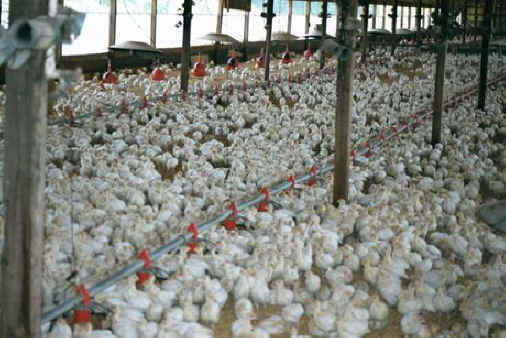
By “conventional” I mean: either factory farmed in warehouse barns (photo below) or crammed into small wire cages (called batteries) with other chickens and no room to hardly move; they are given a feed that consists of mostly genetically modified (GMO) corn (because it’s cheap) and possibly antibiotics, as they are often sickly under these conditions (geez, who wouldn’t be).  There is far more that can be said about how chickens are being factory farmed these days, but essentially, they are used soley as egg-making machines, have awful living conditions, are stressed, cranky, pissed at their neighbors and fighting all the time; less healthy, not eating their natural diet or able to roam freely as their ancestors before them once did.  This set up allows manufacturers to produce higher volumes of eggs which can in turn be sold to us at a lower cost, ~$2/dozen.

Factory Farmed Chickens / "High Density Floor Confinement" (Photo via)
Knowing this, purchasing quality eggs is one area on my grocery list that I just won't skimp on.  

And oh baby... it’s SO worth it!  Eggs from pastured chickens have a deeper and sweeter taste.  The yolks are golden in color and plump and proud in stature. 


Want more reasons to go out of your way for pastured eggs?


Pastured eggs are nutritionally superior:

·        Up to 10x more omega-3s (roles in brain/nervous system health, joint health, vision health, immune support, anti-inflammatory, etc)

·        3x more vitamin E (anti-oxidant functions, immune building, cancer preventative, preventative against CVD,  anti-inflammatory, etc.)

·        7x more beta carotene (vision health, immune function, gene expression, growth & development, etc.)

·        5x more vitamin D (immune function, nervous system, bone health, gene expression, etc.)

·        No added hormones, antibiotics or other drugs (the way it should be)
·        Less cholesterol and saturated fat (still worried about fat and cholesterol content of eggs?  Check out the: Let's Talk Fat post)
·       Rich in conjugated linoleic acid, CLA (more on CLA in a later post; you're gonna want to know about this “good fat” known for being a potent defense against cancer and more --- stay tuned!)

(Sources: Linus Paulding Institute; Eat Wild)


Ok, so how do we find good quality pastured eggs?

OPTION #1
If you know someone who raises their own chickens in a healthy environment as mentioned above,  you are golden.  And be kind to your local mama pollo.  Expect to pay $3-$5 per dozen.  Or if you are super lucky, you might have a generous neighbor who just keeps you in supply with their extras. 

OPTION #2
If you have a local farmer’s market, get there early and purchase from a local farmer that adheres to the organic pastured standards (just ask).  And of course, be kind to your local farmer as well!  Expect to pay $4-$6 per dozen.  

OPTION #3
Purchase eggs from your local natural foods market.  Read the label as best as you can looking for: organic and pastured. Expect to pay $3-$4 per dozen.  


Organic on the label means: ~80% of their feed is from non-GMO and there are no animal by-products in the feed; they have access to the outdoors year round and are allowed 2 sq ft of floor space.


Pastured on the label means: chickens are typically in a moveable enclosure where there is access to fresh growing vegetation.


But let's be clear: there are numerous words on egg cartons these days (free range, cage free, day range, free roaming, roaming free, etc).  For example: "free range" on the label doesn't necessarily mean or guarantee anything... it's loosely regulated, further making understanding egg labeling torturous and confusing --- which is why options 1 and 2 are preferred.  Rodale has a nice article on new labeling laws that may come into play making this easier on the consumer.


Here's a fantastic link that can help you find a CSA or farm in your area:
http://www.localharvest.org/

Does all this make your head spin?  Yes, mine too. Let's move on to the eating part. 

The egg is gloriously versatile and is used in baking, meringues, Italian desserts, eggnog, cocktails, stirfries; it can be scrambled, cooked over easy, poached, fried, hard boiled; you can make omelets, quiches, soufflĂ©s, frittatas, you name it!  It's a chef's delight, for sure.

One simple breakfast favorite in our house is an egg over easy/medium served over a bed of quinoa.  ...Along with some fresh ground kelp and a generous handful of cilantro (yes, we sort of like cilantro!).


Pastured egg over easy over bed of quinoa with side of fruit
But another favorite is making a frittata, which can easily make a delicious, high protein, veggie-filled meal for breakfast, lunch or dinner.  Below is a recipe for a Savory Vegetable and Caramelized Onion Frittata.  
Savory Vegetable and Caramelized Onion Frittata
So.... what is your favorite egg dish? 


And tell me I am not the only one who dreams of living in the country again ... a big yard complete with a designated chicken playground and all the fresh pastured eggs I can imagine...?


Savory Vegetable & Caramelized Onion Frittata
________________________________________________________________________

Frittatas are such a wonderful way to kickstart your day by serving up a flavorful dish, high in protein and packed with a bounty of beautiful vegetables.  For a balanced meal, partner this fabulous frittata with a side of whole grain toast and fresh, in season fruit topped with a dollop of cultured whole milk yogurt.  Feel free to change up the spices and the vegetables to suit your fancy – it’s hard to go wrong!
________________________________________________________________________

Preparation time: 30 minutes
Makes 2-4 servings (6 slices)

2 teaspoons butter, divided
½ yellow onion, sliced into half moons
4 shitake mushrooms, thinly sliced
¼ red bell pepper, julienned
2 cloves of garlic, roughly chopped
2 leaves of kale, coarsely chopped
6 eggs
3 tablespoons whole milk
¼ teaspoon sea salt
¼ teaspoon ground white pepper
1 teaspoon ground coriander
3 tablespoons coarse grated carrot
2 tablespoons fresh chopped parsley, plus more to garnish
1/3 cup grated mild cheddar cheese


Set oven to broil.

Heat a medium-size stainless steel pan over medium heat.  Add 1 teaspoon of butter.  Add the onions and cook for about 15 minutes until they are almost caramelized.  Add the mushrooms and bell pepper.  SautĂ© together for 3-4 more minutes.  Add the garlic and kale and cook for another minute or so until kale turns bright green and begins to wilt.  remove from heat and set mixture aside.

Whisk eggs and milk together in a medium size bowl.  Mix in the salt, pepper and coriander.  Over medium-high heat, re-heat the same pan that was used to cook the vegetables and coat evenly (especially around the sides) with the remaining teaspoon of butter.  Add the egg mixture and cook about 75% of the way without stirring; there will still be uncooked yolk on the top. Add the cooked vegetables and then top with the carrot, chopped parsley and cheese. 

Place the skillet in the oven to broil for about 3-4 minutes, until the cheese is a little golden and bubbly.  Keep an eye on it so it doesn’t burn  Remove from the oven, slice into 6 pieces and serve garnished with a little extra parsley.


Copyright 2010, S. Nester, Original recipe

Tell me what's on your mind!

Click the comments link below the post to share your thoughts.